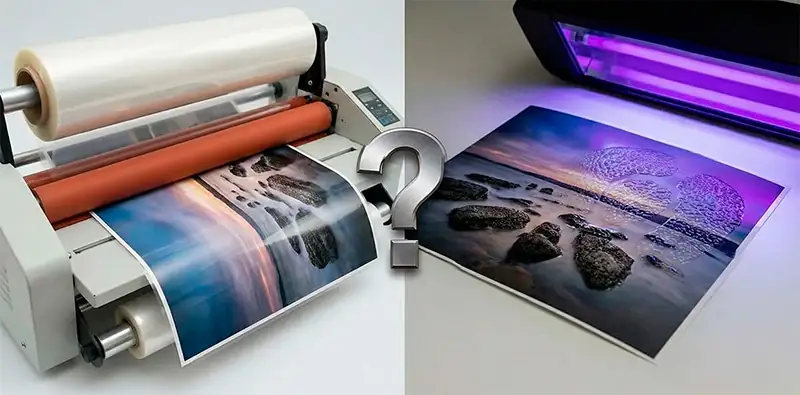
Both coatings protect printed products and give them a premium look. But they differ significantly. Let's figure out which is better for your case.
Lamination
Lamination is the application of a thin film to the surface of printed products. The film adheres to the paper under the influence of heat and pressure.
Types of Lamination:
- Glossy — shiny, bright, enhances colors
- Matte — muted, elegant, no glare
- Soft-touch — velvety to the touch, premium feel
✅ Advantages of Lamination:
- Complete protection from moisture, dirt, abrasion
- Significantly increases durability
- Covers the entire surface evenly
- Pleasant to the touch (especially soft-touch)
- Durability
❌ Disadvantages of Lamination:
- More expensive than UV varnish
- Cannot write on the surface
- Impossible to do selectively (partially)
UV Varnish
UV varnish is a liquid coating that hardens under ultraviolet light. Can be applied continuously or selectively.
Types of UV Varnish:
- Solid — covers the entire surface
- Selective — covers only individual elements (logo, text, photo)
✅ Advantages of UV Varnish:
- Can be applied selectively — creates a striking contrast
- Cheaper than lamination
- Bright glossy effect
- Fast drying
❌ Disadvantages of UV Varnish:
- Less protection than lamination
- Can crack when bent
- Surface may scratch
Comparison Table
| Parameter | Lamination | UV Varnish |
|---|---|---|
| Protection | ⭐⭐⭐⭐⭐ | ⭐⭐⭐ |
| Price | Higher | Lower |
| Selectivity | No | Yes |
| Look | Premium | Bright |
| Touch | Pleasant | Smooth |
What to Choose?
Choose lamination if:
- Maximum protection is needed (business cards carried in a wallet)
- You want a premium look and feel
- Product will be used frequently
Choose UV varnish if:
- You want to highlight individual elements (spot varnish)
- Budget savings are important
- A bright glossy effect is needed
Ideal for premium business cards: matte lamination + spot UV varnish on the logo. Looks luxurious!