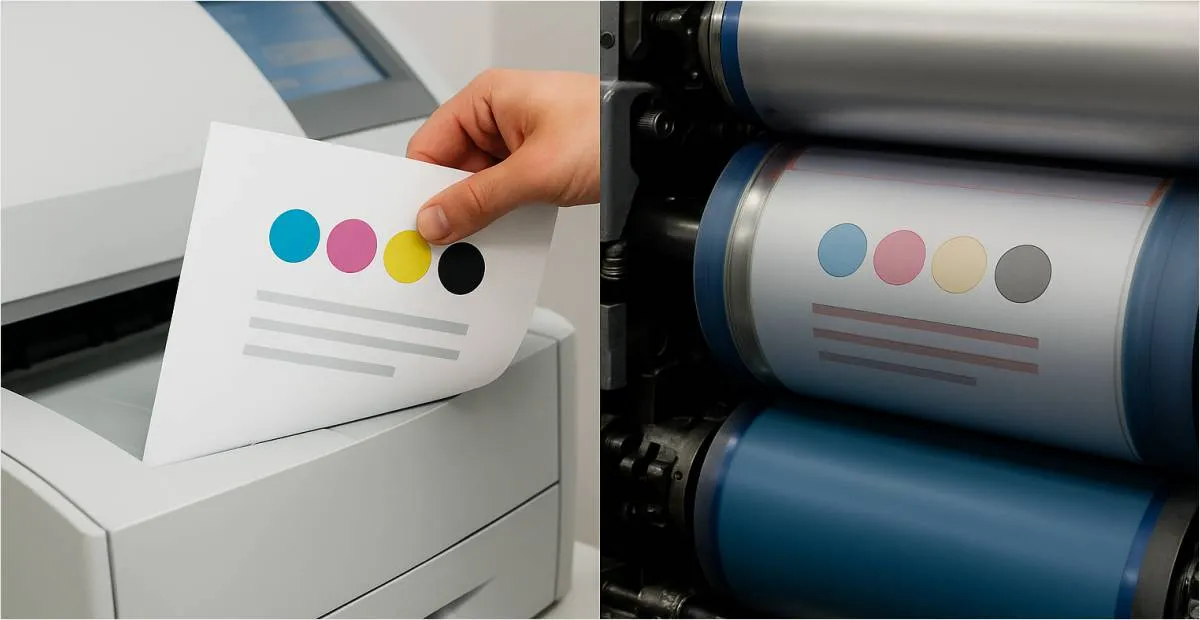
Digital or offset printing: what to choose for your order?
In the world of printing, there are two main methods of sheet-fed printing — digital and offset. Both have their advantages and are suitable for different tasks. Let's look at the difference and when to use which method.
How these technologies work
- Digital printing — printing directly from an electronic file, where ink is applied directly to the paper.
- Offset printing — ink is first transferred to a printing plate, then to an intermediate offset cylinder, and only then to the paper.
- Main difference: digital printing does not require the production of printing plates, so the start-up is much faster.
Comparison by key criteria
1. Minimum run
Digital: from 1 copy.
Offset: usually from 500 copies.
2. Color reproduction
Digital: uses the CMYK model, but does not always reproduce all shades
perfectly.
Offset: also CMYK, however, Pantone colors can be added for the most accurate
reproduction.
3. Start-up speed
Digital: printing can start immediately after uploading the file.
Offset: time is needed for preparation — color separation and plate making.
4. Printing speed
Digital: 5,000–7,000 pages/hour.
Offset: up to 18,000 prints/hour.
5. Ability to make changes
Digital: changes to the layout can be made even during the printing process.
Offset: requires making new plates.
What to choose?
There is no single universal solution. If you need small runs, a quick start, and the ability to adjust the design in the process, the choice is obvious — digital printing.
If the order is large, perfect color reproduction and minimal cost per copy are needed, offset printing is better.
💡 At DrukPlus we will help!
We select the optimal printing method for each specific project — so that it is economical, fast, and of the highest quality.
Order printing online