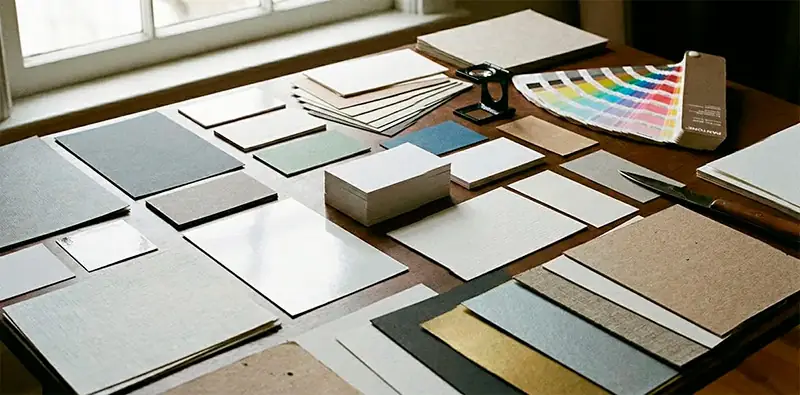
A business card is the first impression of you and your business. And the paper it is printed on plays a huge role in this impression. Let's figure out how to choose the ideal paper for your business cards.
Paper Density
Density is measured in grams per square meter (g/m²). For business cards, paper from 250 to 450 g/m² is used.
250 g/m² — Economy
Suitable for temporary business cards or large runs where economy is important. Paper is thinner, but still dense enough for a business card.
350 g/m² — Standard
The most popular option. Optimal price-quality ratio. The business card feels solid, does not bend easily.
450 g/m² — Premium
For those who want to make a maximum impression. Such business cards are associated with reliability and success.
Our advice: for most businesses, the optimal choice would be 350 g/m² paper. It is dense enough to make a good impression, and not too expensive.
Coating Types
Coating protects the business card and gives it a special look.
- Glossy Lamination — shiny surface, bright colors. Ideal for photos and bright designs.
- Matte Lamination — elegant muted look. Pleasant to the touch, leaves no fingerprints.
- Soft-touch Lamination — velvety surface. Premium feel, memorable.
- UV Varnish — glossy coating of individual elements. Can highlight logo or text.
What to Choose for Your Business?
The choice depends on the field of activity and the image you want to create:
- Lawyers, financiers, consultants — matte lamination, 350-450 g/m² paper. Solidity and reliability.
- Creative agencies, designers — can experiment: unusual shapes, soft-touch, spot varnish.
- Restaurants, cafes — glossy lamination for bright photos of dishes.
- Craftsmen, repairmen — practical option 300-350 g/m² with lamination for protection from dirt.
Summary
When choosing paper for business cards, consider:
- Budget — the higher the density and more complex the coating, the more expensive
- Brand image — paper must match your positioning
- Practicality — if business cards are often given in "field" conditions, lamination is mandatory
If you are in doubt — write to us, we will help you choose the best option for your case!